The Quiet Truth Behind Her Eyes
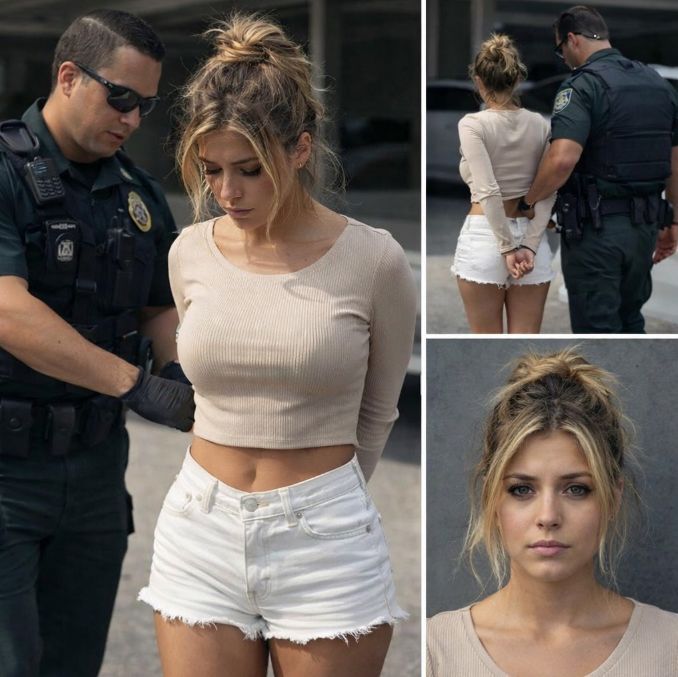
The moment the officer placed the cold metal cuffs around her wrists, the world seemed to shrink into silence. People passed by, some pretending not to notice, others staring too long. But she didn’t look at any of them. Her gaze stayed fixed on the ground, as if the pavement beneath her feet held answers no one else could see.
Her name was Elara.
To strangers, she looked like any other young woman—carefree, maybe even reckless. Her messy blonde hair was tied up in a loose bun, strands falling softly around her face. She wore a simple outfit: a fitted long-sleeve top and white shorts, the kind someone might wear on a warm afternoon without a second thought. But nothing about this moment was ordinary.
The officer guiding her to the patrol car kept his grip firm, yet not aggressive. He had seen many arrests before—some loud, some violent—but this one felt different. She wasn’t resisting. She wasn’t crying. She wasn’t even speaking.
That was what unsettled him the most.
Hours earlier, Elara had been sitting at a small café on the corner of Maple Street. She had ordered coffee but barely touched it. Her phone lay face down on the table, buzzing occasionally with messages she chose not to read. Around her, life moved on—laughter, conversations, the clinking of cups—but she felt detached, like she didn’t belong in that moment.
She knew it was coming.
For weeks, she had carried the weight of a secret—one that grew heavier with each passing day. It wasn’t just fear of being caught; it was the burden of knowing what she had done, and why she had done it. The truth wasn’t simple. It never was.
People would say she made a choice.
But they wouldn’t understand the circumstances behind it.
No one would see the late nights, the desperation, the impossible decisions that led her here. No one would hear the voices in her head arguing between right and wrong, survival and morality.
When the officers approached her at the café, she didn’t run. She didn’t argue. She simply stood up, as if she had been waiting for them all along.
“Miss Elara?” one of them had asked.
She nodded.
And just like that, her life changed.
Now, standing outside the station with her hands bound behind her back, she finally lifted her eyes for a brief moment. Not toward the officer. Not toward the crowd.
But toward the sky.
It was clear and bright, almost painfully beautiful. The kind of day that felt unfair for something so heavy.
A small flicker of emotion crossed her face—regret, maybe. Or relief.
Because in some strange way, this was the end of running.
Inside the station, they would ask questions. They would piece together the story from evidence and assumptions. They would build a version of her life that fit neatly into reports and files.
But they wouldn’t know the whole truth.
They wouldn’t know about the person she tried to protect.
They wouldn’t know about the moment everything went wrong.
They wouldn’t know that what she did, she believed—deep down—was the only choice she had.
As the officer opened the car door and guided her inside, she didn’t resist. She sat quietly, her posture straight, her expression calm.
The door shut with a heavy sound.
And just like that, the outside world disappeared.
In the reflection of the window, her face stared back at her—tired, but steady. There were no tears, no panic. Just a quiet acceptance.
Whatever came next, she would face it.
Because sometimes, the truth isn’t about innocence or guilt.
Sometimes, it’s about the reasons no one ever asks to understand.